


Mind Code: The Journal of Universal AI Architecture
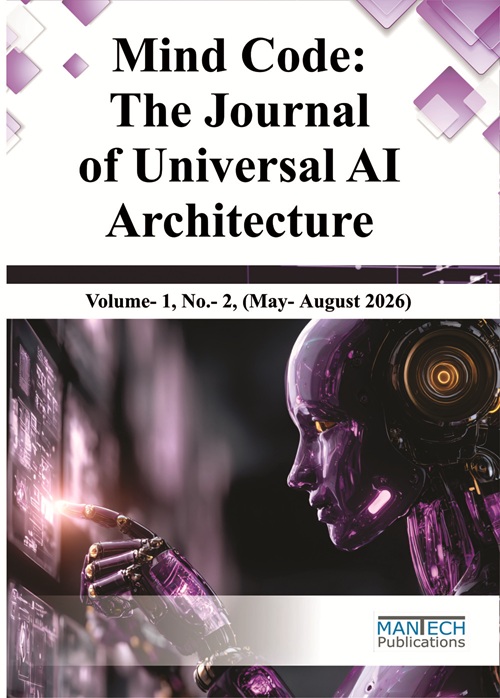
Mind Code: The Journal of Universal AI Architecture, published by Mantech Publications, is a peer-reviewed international journal dedicated to the exploration of unified frameworks and architectures for Artificial Intelligence. The journal welcomes original research, theoretical studies, and applied innovations focused on building scalable, adaptable, and human-aligned AI systems. By integrating insights from machine learning, cognitive science, neuroscience, and computational theory, MindCode seeks to advance the development of universal intelligence models. It serves as a global forum for researchers and practitioners to discuss the foundations, ethics, and future directions of AI architecture. Committed to academic excellence, the journal promotes responsible and transformative progress in universal AI research.
Journal Particulars
| Title | Mind Code: The Journal of Universal AI Architecture |
| Issues Per Year (Frequency) | 3 issues (April, August, December) |
| Format of Publication | Online + Print |
| Starting Year | 2026 |
| Subject | Engineering |
| Type of Publication | Peer-reviewed Journal (Refereed Journal) |
| Language | English |
| Publisher | Mantech Publications Pvt. Ltd. |
| Publication Address | 402, 4th Floor, Plot No-127, Gyankhand-1, Indirapuram, Ghaziabad-201014 Uttar Pradesh (U.P.) |
| Email id | info@mantechpublications.com, mantechpublications@gmail.com |
| Contact No | 7838047803, 0120 – 4076613 |
| Copyright | © Mantech Publications Pvt. Ltd |
| Readership | Professors, Research Scholars, Students, Engineers |
| Website | https://mantechpublications.com/mindcode-the-journal-of-universal-ai-architecture/ |
| Indexed in | Google Scholar, Crossref, Figshare, Zenodo, DOI |
| Editor -in-Chief | Dr. Sandeep G. Sutar |
| ISSN |
Editorial Board
Editor-in-Chief
Dr. Sandeep G. Sutar
Designation: Professor
Department: Computer Science & Engineering
College Name: Annasaheb Dange College of Engineering and Technology, Ashta
Address: Ashta, Dist. Sangli, Maharashtra.416 301
Official Email id:
sgs_cse@adcet.in
Dr. Sachin P. Patil
Designation : Professor
Department: Computer Science & Engineering
College Name: Annasaheb Dange College of Engineering and Technology (ADCET), Ashta
Address: Ashta, Dist. Sangli, Maharashtra.416 301
Official Email id:
spp_cse@adcet.in
Dr. Ambika Gupta
Designation: Asst. Professor
Department: Computer Science & Engineering
College Name: Sharda University Agra
Address: Sharda University Agra, 18 KM from bhagwan talkies towards Mathura, Agra-Delhi Highway (NH-19), Keetham, Agra – 282007
Official mail id:
ambika.gupta@agra.sharda.ac.in
Dr. Harsh Kumar
Designation: Professor
Department: Computer Science and Engineering
College Name: School of Engineering and Technology, Shri Guru Ram Rai University Dehradun
Official Email id:
harshkusing856@sgrru.ac.in
Dr. Madhura J
Designation: Assistant professor
Department: Computer Science and Engineering Manufacturing Processes, Mechanical Engineering.
Email id: madhu-ise@dayanandasagar.edu
Mind Code: The Journal of Universal AI Architecture
Mind Code: The Journal of Universal AI Architecture is an academic research journal focused on advanced artificial intelligence architectures, Artificial General Intelligence (AGI), cognitive systems, autonomous intelligence, and emerging approaches to building adaptable AI systems. The journal provides a scholarly platform for researchers, academicians, technology professionals, and students working on new ideas in universal AI and intelligent computing.
Current research published in the journal covers areas such as hierarchical AI architectures, dynamic memory, meta-learning, continual adaptation, neuro-symbolic systems, knowledge models, cognitive architectures, embodied AI, and autonomous reasoning.
For researchers and authors, the journal provides an academic space to present original research, review studies, theoretical models, architecture designs, experimental findings, and emerging ideas related to universal artificial intelligence. For institutions and libraries, it provides access to research covering fast-developing areas of AI architecture and general intelligence.
Mind Code: The Journal of Universal AI Architecture – Scope and Focus
The scope of Mind Code: The Journal of Universal AI Architecture covers the design, development, analysis, and evaluation of AI systems intended to work across multiple tasks, environments, and knowledge domains.
The journal welcomes research on intelligent architectures that combine learning, reasoning, memory, planning, perception, adaptation, and decision-making. Studies may explore theoretical frameworks, computational models, experimental systems, simulations, benchmarks, or practical AI applications.
Universal Artificial Intelligence
Universal AI research explores architectures that are not limited to one narrow task or application. Such systems aim to transfer knowledge, adapt to new situations, and operate across different problem domains.
Research may address general-purpose learning, flexible reasoning, task transfer, knowledge integration, autonomous decision-making, and scalable AI system design. These topics are important for researchers exploring future directions in AGI and intelligent systems.
Artificial General Intelligence and Cognitive Architectures
Artificial General Intelligence is an important area within the journal’s research scope. Mind Code: The Journal of Universal AI Architecture supports academic research examining how AI systems can integrate different cognitive capabilities into unified architectures.
Research can cover perception, reasoning, planning, memory, learning, language understanding, problem-solving, and self-reflection. Cognitive architectures and universal knowledge models are also important research areas for understanding how intelligent systems can manage information across diverse tasks.
Adaptive and Continual Learning
AI systems increasingly need to learn from changing information rather than depending only on fixed training data. Therefore, continual learning and adaptive AI architectures form an important part of the journal’s scope.
Authors may submit research on lifelong learning, dynamic memory, meta-learning, knowledge adaptation, transfer learning, catastrophic forgetting, and systems that update their capabilities as new tasks appear. Research published in the journal includes work examining dynamic memory, meta-learning, and continual adaptation in scalable universal AI architectures.
Neuro-Symbolic AI and Knowledge Representation
Combining neural learning with symbolic reasoning is another important direction in universal AI research. Neuro-symbolic systems bring together pattern learning, structured knowledge, logical reasoning, and knowledge representation.
Mind Code: The Journal of Universal AI Architecture welcomes research on knowledge graphs, symbolic reasoning, vector-symbolic systems, differentiable logic, hybrid AI models, and neural-symbolic integration. These approaches are relevant to researchers investigating more structured and explainable forms of intelligent computing.
Multi-Agent and Hierarchical AI Systems
Modern AI applications increasingly involve multiple intelligent agents working within complex environments. Research in this area may examine communication, coordination, planning, hierarchical decision-making, decentralized control, and multi-agent learning.
The journal also covers hierarchical AI architectures in which different levels of a system manage long-term goals, tactical decisions, and lower-level actions. Such research contributes to the development of scalable intelligent systems for complex environments.
Autonomous Reasoning and Decision-Making
Autonomous reasoning is a central topic for researchers developing advanced AI systems. Research may investigate goal planning, logical inference, decision models, self-correction, uncertainty handling, and autonomous problem-solving.
Authors can explore how AI architectures combine different reasoning methods to process information and make decisions across changing conditions. Research on modular AI architectures has examined cross-domain knowledge integration and multi-step autonomous reasoning.
Mind Code: The Journal of Universal AI Architecture for Researchers
Mind Code: The Journal of Universal AI Architecture provides a focused research platform for scholars working on advanced AI architectures. Researchers can submit studies related to theoretical AI, computational intelligence, machine learning, AGI, cognitive computing, autonomous systems, and intelligent agents.
The journal is relevant to researchers from computer science, artificial intelligence, data science, robotics, cognitive computing, mathematics, engineering, and related interdisciplinary fields.
Mind Code: The Journal of Universal AI Architecture for Students
Students and early-career researchers can use the journal as a source of academic research on emerging AI technologies. Reading research papers can provide insight into current approaches, technical challenges, architecture designs, and future research directions.
Student researchers working on dissertations, projects, theses, and research papers may find topics such as AGI, neural-symbolic AI, meta-learning, autonomous systems, cognitive architectures, and continual learning particularly relevant.
Generative AI and Intelligent Systems
Generative AI is another developing area connected with universal intelligence and advanced AI architectures. Research can examine generative models, multimodal systems, computational creativity, design systems, language models, and AI-assisted knowledge generation.
The journal’s published research includes work examining generative AI across creative and design domains, including questions surrounding originality, authorship, ethics, and responsible AI development.
Embodied AI and Real-World Intelligence
Embodied AI connects digital intelligence with physical environments. Research in this area can cover robotics, sensing, actuation, human-machine interaction, cyber-physical systems, autonomous navigation, and intelligent machines.
Such research is important for understanding how AI systems can perceive their surroundings, reason about real-world situations, and perform actions. The journal has published research examining embodied AI systems across robotics, manufacturing, healthcare, and urban applications.
Explainable, Responsible, and Trustworthy AI
As AI systems become more complex, researchers are also studying transparency, explainability, safety, accountability, and responsible AI development.
Mind Code: The Journal of Universal AI Architecture welcomes research that examines how advanced architectures can provide understandable reasoning, manage uncertainty, support human oversight, and address ethical challenges. These areas are especially relevant when intelligent systems are applied to sensitive or high-impact environments.
AI Architecture for Future Applications
Universal AI architecture has potential research connections across robotics, healthcare, finance, education, transportation, manufacturing, smart cities, cybersecurity, scientific computing, and other technology-intensive fields.
Research can examine how adaptable AI architectures are designed for different environments while addressing scalability, reliability, computational resources, data management, and human interaction.
Benefits for Academic Institutions and Libraries
Mind Code: The Journal of Universal AI Architecture can serve as a useful academic resource for colleges, universities, libraries, research centres, and technology-focused institutions.
Institutional subscribers can provide researchers and students with access to current academic work covering AI architecture, AGI, machine learning, cognitive systems, autonomous intelligence, and related areas. A focused journal collection can also support classroom learning, research projects, dissertations, seminars, and interdisciplinary studies.
Peer-Reviewed Research and Academic Communication
Mind Code: The Journal of Universal AI Architecture is listed by Mantech Publications among its peer-reviewed Artificial Intelligence and Machine Learning journals.
The journal’s published research demonstrates a broad academic focus, including theoretical reviews, architecture studies, computational frameworks, and emerging AI research topics.
For authors, publishing research provides an opportunity to communicate technical ideas with readers interested in advanced artificial intelligence and universal AI systems.
Emerging Trends in Universal AI
Universal AI research continues to develop across several connected areas. These include multimodal intelligence, autonomous agents, continual learning, neuro-symbolic reasoning, cognitive architectures, dynamic memory, meta-learning, embodied intelligence, and scalable AI systems.
Researchers are also examining how different components can work together rather than relying on a single model or technique. This creates opportunities for interdisciplinary research connecting artificial intelligence with robotics, mathematics, cognitive science, engineering, and computer science.
Publishing Opportunities for Authors
Authors can consider Mind Code: The Journal of Universal AI Architecture for research related to universal AI systems and advanced intelligent architectures.
Relevant submissions may include original research, review studies, theoretical research, architecture frameworks, computational models, experimental investigations, and interdisciplinary studies related to the journal’s scope.
Researchers can use the journal to communicate new findings, explore unresolved technical problems, and contribute to academic discussions surrounding the future of artificial intelligence.
Advancing Universal AI Research
Mind Code: The Journal of Universal AI Architecture focuses on an important research question: how can AI architectures become more adaptable, scalable, interconnected, and capable across different tasks and environments?
By bringing together research on AGI, cognitive architectures, learning systems, reasoning, memory, autonomous agents, neuro-symbolic AI, and embodied intelligence, the journal provides a focused academic space for exploring the architecture of future intelligent systems.
For researchers, students, academicians, and institutions interested in advanced artificial intelligence, Mind Code: The Journal of Universal AI Architecture offers a dedicated platform for exploring new research, sharing academic findings, and following developments in universal AI architecture.