


Journal of AI Ethics and Autonomous Systems
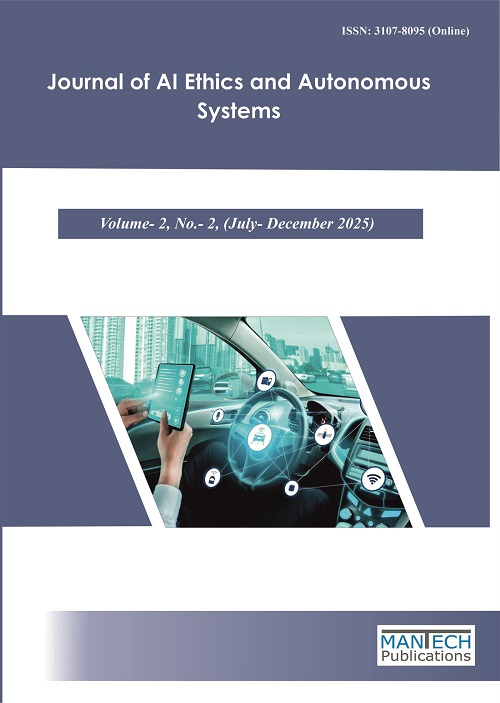
The Journal of AI Ethics and Autonomous Systems is an authoritative national publication by Mantech Publications, dedicated to examining the ethical, legal, and societal dimensions of artificial intelligence and autonomous technologies. It features peer-reviewed research addressing topics such as fairness, accountability, transparency, and governance in AI-driven systems. The journal aims to foster dialogue between ethicists, technologists, and policymakers by presenting thought-provoking analyses, case studies, and best practices. It serves as a valuable platform for scholars and practitioners committed to responsible and socially conscious AI development.
Journal Particulars
| Title | Journal of AI Ethics and Autonomous Systems |
| Issues Per Year (Frequency) | 2 issues (June, December) |
| Format of Publication | Online + Print |
| Starting Year | 2024 |
| Subject | Engineering |
| Type of Publication | Peer-reviewed National Journal (Refereed Journal) |
| Language | English |
| Publisher | Mantech Publications Pvt. Ltd. |
| Publication Address | 402, 4th Floor, Plot No-127, Gyankhand-1, Indirapuram, Ghaziabad-201014 Uttar Pradesh (U.P.) |
| Email id | info@mantechpublications.com, mantechpublications@gmail.com |
| Contact No | 7838047803, 0120 – 4076613 |
| Copyright | © Mantech Publications Pvt. Ltd |
| Readership | Professors, Research Scholars, Students, Engineers |
| Website | https://mantechpublications.com/journal-of-ai-ethics-and-autonomous-systems/ |
| Indexed in | Google Scholar, Crossref, Figshare, Zenodo, DOI |
| Editor -in-Chief | Dr. Ketan Sarvakar |
| ISSN | 3107-8095 (Online) |
Editorial Board
Editor-in-Chief
Dr. Ketan Sarvakar
Designation: Assistant Professor
Department: Information Technology
Email ID:
ketan.sarvakar@uuituniversity.ac.in
Prof. Mohit Tiwari
Designation: Assistant Professor
Department: Computer Science and Engineering
Email ID: mohit.tiwari@360vidyapeeth.edu
Dr. Sanjay Pachauri
Designation: Professor
Department: Computer Science and Engineering
Email id:
sanjaypachauri.cse@83t.net.in
Dr. Harsh Kumar
Designation : Professor and Dean
Department: School of Computer Applications
Email id:
deanca@vi54.ac.in
Dr.Urmila S Soni
Designation: Professor
Department: Electronics & Communication Engineering
Official mail id:
ussoni@rprrkk.edu
Journal of AI Ethics and Autonomous Systems
The Journal of AI Ethics and Autonomous Systems is a peer-reviewed national publication designed to explore the ethical, legal, and societal dimensions of artificial intelligence and autonomous technologies. It serves both subscribing institutions and authors, offering a valuable platform for critical discourse, innovative research, and responsible AI development.
The Purpose of the Journal of AI Ethics and Autonomous Systems
The Journal of AI Ethics and Autonomous Systems bridges crucial conversations between ethicists, technologists, and policymakers. Topics include AI fairness, accountability, transparency, and governance in autonomous systems. It connects institutions seeking ethical frameworks with researchers dedicated to socially conscious AI.
Why Institutions Subscribe to the Journal of AI Ethics and Autonomous Systems
Colleges, universities, and research libraries rely on the Journal of AI Ethics and Autonomous Systems for:
- Access to scholarly analyses and case studies on AI ethics and governance
- Ethical insights that inform curriculum development and institutional policies
- A curated resource for responsible AI programs and research initiatives
- Engagement with internationally peer-reviewed content on emerging AI challenges
Why Authors Choose the Journal of AI Ethics and Autonomous Systems
For scholars and students, the Journal of AI Ethics and Autonomous Systems offers:
- A respected platform to publish research on AI ethics, transparency, and accountability
- Rigorous peer review from interdisciplinary experts in ethics, law, and technology
- Increased visibility among institutions focused on socially responsible AI
- An opportunity to lead dialogue on ethical frameworks for autonomous systems
Core Themes in the Journal of AI Ethics and Autonomous Systems
The Journal of AI Ethics and Autonomous Systems emphasizes research in:
- Fairness and Bias in AI Systems
- Accountability and Governance of Autonomous Technology
- Transparency and Explainable AI
- Regulatory and Legal Aspects of AI
- Ethical Frameworks for Autonomous Systems
- Societal Impacts of AI Technologies
- Case Studies in AI Ethics and AI Failure Analysis
- Best Practices for Responsible AI Development
Value for Subscribing Institutions
Institutions subscribing to the Journal of AI Ethics and Autonomous Systems gain access to a leading resource in ethical AI:
- Supports curriculum and policy development in AI ethics
- Enhances research programs focused on societal and legal implications of AI
- Forges a foundation for student projects on equity, ethics, and governance in technology
- Positions institutions as leaders in responsible AI discourse
Advantages for Authors and Researchers
Authors publishing in the Journal of AI Ethics and Autonomous Systems benefit in multiple dimensions:
- Contribute to globally relevant conversations on AI ethics and transparency
- Receive critical feedback through peer review to strengthen research impact
- Increase academic standing through publication on pressing social topics
- Influence institutional practices and policy through robust ethical advocacy
Rising Trends in the Journal of AI Ethics and Autonomous Systems
The Journal of AI Ethics and Autonomous Systems regularly highlights emerging trends, including:
- Ethical AI Frameworks for Autonomous Mobility and Robotics
- Explainable AI and Algorithmic Transparency
- Governance Models for AI Systems in Public Services
- Bias Detection and Mitigation in Machine Learning
- Legal Compliance and AI Accountability Mechanisms
Academic Applications of the Journal of AI Ethics and Autonomous Systems
For students and professors, the Journal of AI Ethics and Autonomous Systems is a trusted academic tool:
- Offers reliable sources for theses and research projects on AI ethics
- Supports faculty teaching with real-world ethical case studies and policy discussions
- Enhances capstone projects in AI-safe design, governance, and transparency frameworks
The Peer Review Process in the Journal of AI Ethics and Autonomous Systems
The Journal of AI Ethics and Autonomous Systems maintains a high standard of integrity through its peer review system. Each submission is evaluated by interdisciplinary experts—ensuring ethical, legal, and technological rigor—so both subscribers and authors receive credible, impactful content.
Linking Academia, Industry, and Society via the Journal of AI Ethics and Autonomous Systems
The Journal of AI Ethics and Autonomous Systems serves as a critical platform uniting academic thought and real-world application. Institutions gain ethical insights for system design, while researchers draw inspiration from industry challenges—driving innovation in trustworthy and equitable AI.
Why Choose the Journal of AI Ethics and Autonomous Systems
The Journal of AI Ethics and Autonomous Systems stands out as a vital resource in responsible AI research. Subscribers gain access to deep ethical analyses; authors gain a trusted outlet to share high-impact work. With its focus on transparency, fairness, and governance, the journal is central to shaping the ethical future of AI, autonomous systems, and institutional leadership in technology.