


Last Updated: 15 July 2026
The landscape of Indian higher education is undergoing an unprecedented paradigm shift. For decades, the National Assessment and Accreditation Council (NAAC) has served as the ultimate benchmark for academic quality across India. However, with the National Education Policy (NEP) 2020 in full motion and the introduction of radical structural reforms, the parameters of institutional excellence have been completely redefined. Today, securing NAAC Accreditation is no longer just a badge of honor or an optional marketing credential for private colleges. It has evolved into a critical, high-stakes operational imperative that directly impacts an institution’s survival, central funding, legal standing, and public reputation.

Whether you operate an engineering college, a pharmacy institute, a nursing school, or a multi-disciplinary university, understanding the step-by-step pathway to successful accreditation is paramount. Yet, many institutions struggle with fragmented documentation, data mismatches, and a lack of process-driven preparation. Many open the official portal prematurely before performing their due diligence, leading to unexpected rejections and expensive delays. This comprehensive, authoritative 2000-word guide breaks down the entire NAAC accreditation lifecycle under the newest 2026 guidelines, providing practical, step-by-step strategies to transition your college from zero to a high-performing quality hub.
1. Understanding the New NAAC Accreditation Paradigm: Binary vs. MBGL Framework
To prepare effectively, you must first understand that the old system of Cumulative Grade Point Average (CGPA) and letter grades (ranging from A++ down to C) has been replaced. NAAC has fully transitioned to a dual-tier quality assessment model designed to reduce hyper-competition, simplify procedures, and eliminate subjective corrupt inspection practices. This transition consists of two distinct stages:
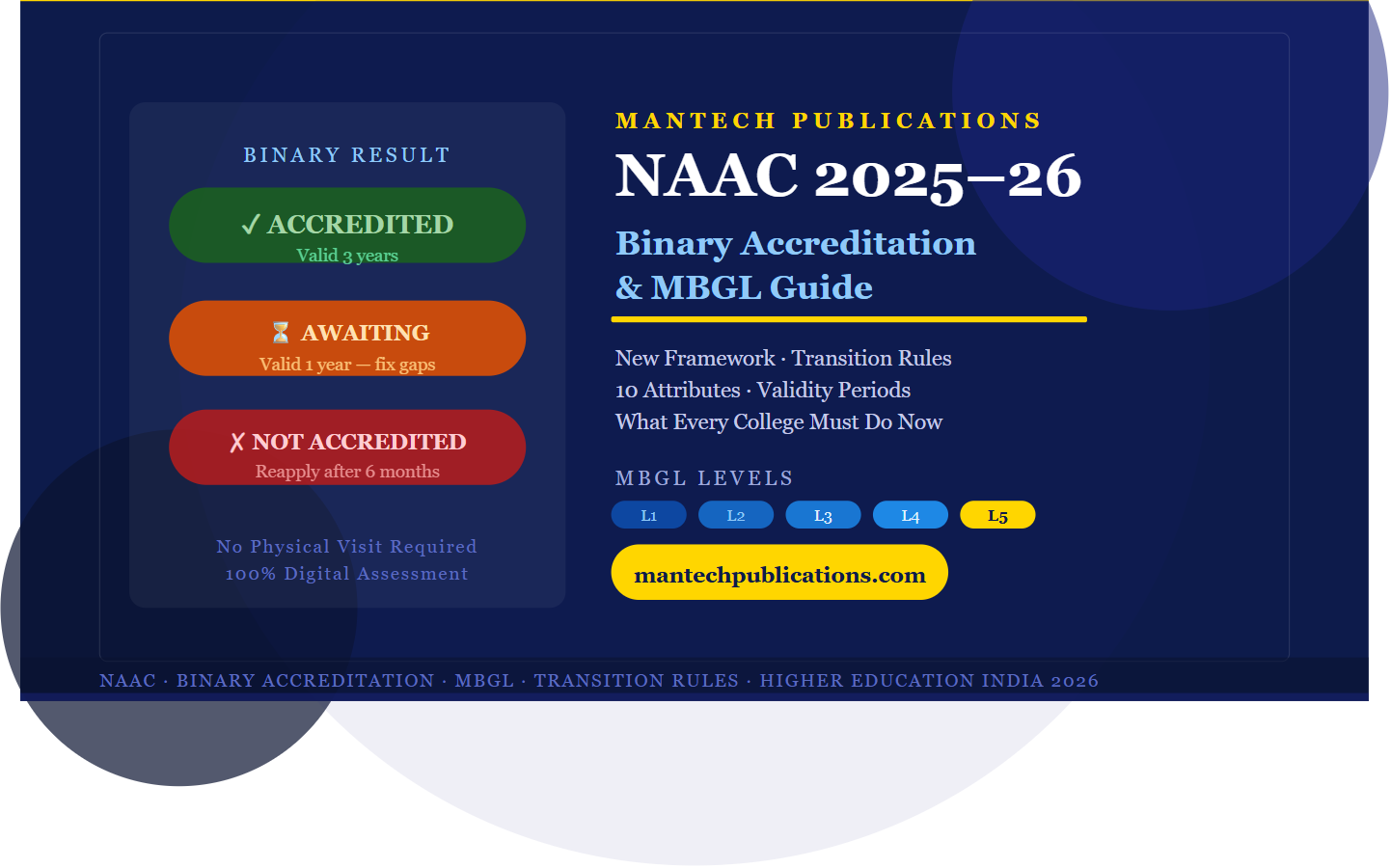
- Binary Accreditation: The first milestone for any institution is to achieve ‘Accredited’ status. Unlike the old subjective grading system, Binary Accreditation has only three possible outcomes: ‘Accredited’, ‘Concern’ (given a grace period to improve), or ‘Weak’ (not accredited). Under the modern NAAC New Accreditation System, physical visits are largely bypassed at this stage. Instead, NAAC relies heavily on quantitative data verification, digital validation surveys, and real-time cross-checks against centralized national databases.
- Maturity-Based Graded Levels (MBGL): Once an institution clears the Binary threshold and secures its ‘Accredited’ status, it can voluntarily opt to climb the MBGL maturity ladder (ranging from Level 1 to Level 5). Level 5 represents a world-class, globally recognized institution. This tier heavily evaluates academic excellence, pioneering research, global collaborations, patent portfolios, and sustainable institutional governance.
For new ventures or colleges struggling with their first cycle, the primary focus must be establishing bulletproof compliance to secure the ‘Accredited’ binary status before worrying about high MBGL tiers. Working with experienced professionals like Bhavya Gyan Consultants (BGC) can help demystify this transition, ensuring your internal data and quality infrastructure align seamlessly with the updated guidelines.
2. Why NAAC Accreditation is Non-Negotiable for Indian Colleges
Is your college still delaying its NAAC application? Running an unaccredited institution in the current regulatory environment is a highly risky strategy. NAAC accreditation directly unlocks several doors:
- UGC and Central Grants: Unaccredited colleges are strictly ineligible for central funding, research grants, and financial support under schemes like Rashtriya Uchchatar Shiksha Abhiyan (RUSA) and other AICTE schemes.
- National Rankings and Visibility: Holding a valid NAAC status is a baseline prerequisite to participate in the National Institutional Ranking Framework (NIRF). Without it, your institution is invisible on the national stage.
- Academic Autonomy: Institutions aiming to design their own curriculum, conduct autonomous exams, and break free from rigid university structures must maintain a top-tier NAAC grade to apply for autonomous status.
- Student and Parent Trust: Today’s tech-savvy students actively look up course scopes and college credentials on platforms like BhavyaGyan Course Directory before locking in their admissions. Unaccredited colleges suffer massive drop-offs in student inquiries and overall enrollment numbers.
3. The Step-by-Step NAAC Accreditation Process
Achieving accreditation is a marathon, not a sprint. Typically, a college requires 9 to 18 months of intensive, organized groundwork before making a formal portal submission. Here is the step-by-step roadmap to navigate this complex process:
Step 1: Institutional Eligibility and Core Readiness Audit
Before touching the NAAC portal, you must verify your structural eligibility. An institution must have been in existence for at least six years since its establishment, OR have had at least two batches of students graduate (whichever is earlier). If you meet this, your next step is running an honest, rigorous gap analysis. For a deep-dive on setting up these early tasks, refer to this step-by-step NAAC Preparation Guide for Colleges.
Step 2: Strengthening the Internal Quality Assurance Cell (IQAC)
The IQAC is the brain of your accreditation campaign. It must not exist merely on paper. It is responsible for hosting regular meetings, defining quality benchmarks, organizing academic audits, and collecting Annual Quality Assurance Reports (AQAR) from every academic department. It serves as the bridge between institutional governance and the NAAC portal.
Step 3: Portal Registration and IIQA Submission
Once your internal readiness is verified, create an account on the official NAAC portal. The first formal submission is the Institutional Information for Quality Assessment (IIQA). The IIQA captures baseline administrative data: courses offered, sanctioned student intake, actual enrollment, faculty strength, and statutory approvals (UGC, AICTE, PCI, INC, etc.). For a detailed checklist on filing this crucial form, read our guide on NAAC IIQA Submission to avoid immediate rejections.
Step 4: Self-Study Report (SSR) Compilation
Upon IIQA approval, your institution has a strict 45-day window to upload the massive Self-Study Report (SSR). The SSR contains hundreds of Quantitative Metrics (QnM) and Qualitative Metrics (QlM). QnM requires hard numerical data backed by raw evidence files, while QlM requires structured descriptive write-ups explaining your institutional practices.
Step 5: Data Validation and Verification (DVV) & Student Satisfaction Survey (SSS)
Once the SSR is submitted, NAAC’s third-party DVV partners initiate an aggressive audit. They cross-check your claims against national data systems (AISHE, NIRF, UDISE+). Any discrepancy results in a ‘DVV Clarification Query’ with a tight 15-day window to reply. Simultaneously, NAAC triggers a digital Student Satisfaction Survey (SSS) to a random subset of your student database, verifying your teaching quality and infrastructure claims firsthand.
Step 6: The Peer Team Visit
For institutions aiming for advanced ratings or climbing the MBGL ladder, a physical Peer Team Visit is conducted. Three to five senior academic experts spend two days on your campus, validating qualitative aspects, inspecting labs, auditing library resources, and interacting with stakeholders (students, alumni, parents, and management).
🎯 Action-Oriented Consultation: Book a Free NAAC Readiness Audit with BGC Specialists to identify critical documentation gaps and build a 10-criteria compliance roadmap before opening the official portal.
4. The 10-Criteria Attribute Mindset vs. Traditional 7 Criteria
While NAAC’s core manuals are still structured around the traditional 7 Criteria, the new Binary Accreditation framework shifts focus onto 10 Key Institutional Attributes. To ensure your college survives the transition, your IQAC must prepare documentation that satisfies both layers simultaneously. The table below illustrates this dual-layer alignment:
| Traditional 7 Criteria | Modern 10 Key Attributes | Critical Evidence Required (DVV-Ready) |
| Criterion 1: Curricular Aspects | Curriculum Design & Academic Flexibility | Syllabus feedback analysis, course lists, value-added certificates, OBE mapping files. |
| Criterion 2: Teaching-Learning & Evaluation | Learning, Teaching & Student Outcomes | Enrolment ratios, student-faculty ratio, Ph.D. certificates, CO-PO attainment sheets. |
| Criterion 3: Research, Innovations & Extension | Research and Innovation Ecosystem | Scopus/WoS journal publication list, UGC-approved research papers, extension reports. |
| Criterion 4: Infrastructure & Learning Resources | Physical & Digital Infrastructure | Library ILMS logs, IT bandwidth bills, purchase invoices, campus maintenance records. |
| Criterion 5: Student Support & Progression | Student Support, Care and Progression | Scholarship receipts, placement records, higher education proof, alumni contribution logs. |
| Criterion 6: Governance, Leadership & Management | Governance, Leadership and Management | Strategic plans, financial audits, professional development programs, IQAC meeting minutes. |
| Criterion 7: Institutional Values & Best Practices | Institutional Values and Best Practices | Green audit reports, gender equity activities, two unique best practices documentation. |
Understanding the correlation between physical infrastructure and student progression is essential. For instance, when documenting Criterion 4, institutions often fail to link library usage directly to research outcomes (Criterion 3). Ensure your team utilizes a structured NAAC Criterion 4 Checklist to maintain consistent records of ICT facilities, IT infrastructure, and library resources.
5. Structuring a Bulletproof IQAC and Documentation System
The most common pitfall in NAAC preparation is ‘last-minute document generation’. Many colleges scramble to compile five years of records in a few weeks, leading to errors, inconsistent data, and ultimate failure. Professional consultants like BGC advocate for a process-driven academic ecosystem. This means establishing a centralized, digital repository where every single event, research paper, faculty appraisal, and student achievement is recorded as it happens.
Here is how to set up a robust documentation workflow:
- Assign Departmental Nodal Officers: Do not leave all documentation to the IQAC coordinator. Appoint one nodal officer per academic and administrative department responsible for compiling their respective criteria files.
- Standardize Formats & SOPs: Ensure all departments use identical templates for event reports, feedback surveys, and faculty profiles. Inconsistencies across departments are heavily penalized during DVV.
- Build a Digital Evidence Repository: Avoid paper mess. Use cloud-based document repositories with structured folders named after specific NAAC sub-criteria (e.g., Folder 2.4.2 for Faculty Ph.D. files). Ensure easy retrieval.
💼 Expert Support: If your team is struggling to structure criteria-wise evidence files, leverage professional NAAC Documentation Support Services from Bhavya Gyan Consultants to systematically compile audit-ready files.
6. Avoiding the Dreaded DVV Pitfalls & Keyword Cannibalization
The Data Validation and Verification (DVV) stage is where most first-time NAAC applications face catastrophic failures. Under the modern Binary platform, NAAC uses automated AI engines to verify institutional claims against other active statutory registries. If your college claims to have 120 full-time faculty, but your AISHE (All India Survey on Higher Education) database listing only shows 80, the AI flags a major discrepancy, destroying your trust rating.
To survive the DVV stage:
- Perform Tri-Database Validation: Cross-verify your SSR data against your AISHE portal, NIRF data, and state university registries before hitting ‘Submit’.
- Avoid Monotonous Data Duplication: Do not submit identical PDF proof files across multiple indicators. Each metric demands unique, context-specific, and signed evidence.
- Beware of Keyword Cannibalization: For multi-domain educational societies operating separate engineering, nursing, and management institutions, ensure your web pages do not target the exact same high-intent keywords (e.g., ‘best engineering college Ghaziabad’). Maintain clear, domain-specific pages to preserve domain authority.
For professional advice on resolving complex DVV queries and organizing DVV-ready files, refer to our complete NAAC Criterion 2 Documentation Checklist to align your teaching-learning evaluations.
7. Action-Oriented Strategies for Institutional Success
Beyond paperwork, achieving premium NAAC results requires driving a continuous culture of quality across the institution. Here are practical strategies you can implement starting today:
- Incorporate Peer-Reviewed Scholarly Resources: Accreditation metrics heavily weight research publications. Partner with established scholarly publishers like ManTech Publications to subscribe to indexed engineering, pharmacy, and management journals. This elevates your Library Resources score (Criterion 4) and drives high-quality faculty research (Criterion 3).
- Execute Structured Mock Audits: Conduct at least two internal mock inspections prior to the final NAAC review. Mock visits train your faculty, prepare department heads for intense cross-questioning, and highlight infrastructure gaps.
- Ethically Boost Student Satisfaction Surveys (SSS): Educate your students about the importance of SSS. Ensure your student database has updated, correct email IDs and mobile numbers to avoid non-responses.
🎓 Admissions & Courses: For prospective students looking to join premier, accredited institutions, browse top-rated programs across India on BhavyaGyan top colleges and courses portal to find your ideal career track.
8. The Role of Outcome-Based Education (OBE) in NAAC 2026
One of the core metrics assessed under NAAC’s learning attributes is Outcome-Based Education (OBE). Modern educational institutions must move away from traditional rote learning assessment methods. Instead, colleges are evaluated on how effectively they map their Program Outcomes (POs), Program Specific Outcomes (PSOs), and Course Outcomes (COs).
To establish high-performing OBE compliance, your departments must showcase active assessment rubrics, direct attainment calculations (based on internal assessments, quizzes, and university exam results), and indirect attainment calculations (sourced from student feedback and exit surveys). Failing to demonstrate a closed-loop feedback mechanism where course coordinators actively tweak the teaching-learning process based on outcome attainment gaps is a common reason for score drops.
9. Optimizing Physical Infrastructure and Maintenance
While academic quality forms the core of NAAC, physical infrastructure provides the vital foundation. Criterion 4 evaluates how effectively your college manages sports facilities, modern laboratories, clean campus environments, and digital libraries. Your IQAC must maintain an active asset registry containing maintenance SOPs, purchase invoices, and logbooks demonstrating the utilization of these assets by students.
Furthermore, environmental sustainability has emerged as a crucial attribute under Criterion 7. Your college should execute periodic green, environment, and energy audits, backed by legitimate certificates from certified external auditors. Simple additions like solar panels, waste segregation systems, rainwater harvesting units, and plastic-free campus campaigns can significantly elevate your institution’s profile.
Frequently Asked Questions About NAAC Accreditation
A: NAAC now focuses on ten attributes, including curriculum, teaching quality, student progression, infrastructure, and research ecosystems, for binary evaluation.
A: A pass-fail system where colleges are certified as either ‘Accredited’, ‘Concern’, or ‘Weak’, bypassing complex letter grading.
A: Maturity-Based Graded Levels (Level 1-5) representing progressive quality tiers achieved voluntarily after clearing Binary Accreditation.
A: A well-organized first-cycle application typically requires nine to eighteen months of comprehensive document compilation and IQAC setup.
A: No, holding a valid NAAC status is mandatory to participate in national NIRF rankings.
External Resources & References
To aid your institution’s preparation, please utilize these official, authoritative governmental resources. All links open in a new tab for seamless access:
- National Assessment and Accreditation Council: Official NAAC Portal
- University Grants Commission India: Official UGC Website
- All India Survey on Higher Education: Official AISHE Portal
Related posts:
![Affordable college journals]()
Cost-Effective Subscription Strategies for Tier-3 Higher Education Institutes: A Practical Guide to …
![NAAC-New-Accreditation-System-2025–26 by mantech Publications]()
NAAC New Accreditation System 2025–26: Binary Accreditation, MBGL Levels, and What Every Indian Coll…
![Digital Spine by mantechpublications]()
Redefining the Digital Spine: An Ergonomic Blueprint for the Modern Human
![Mantech-Publications-Journals Best NAAC Consultancy Services in India by Mantech Publications]()
Best NAAC Consultancy Services in India: How to Choose the Right Partner
![Naac grades are expiring-what to do by Mantech Publications]()
Why Colleges Fail in NAAC Accreditation Even After Good Work
![Mantech-Publications-Journals Best NAAC Consultancy Services in India by Mantech Publications]()
NAAC SSR Report Writing Made Easy: Format, Tips & Real Examples (2026 Guide)






Leave a Reply