


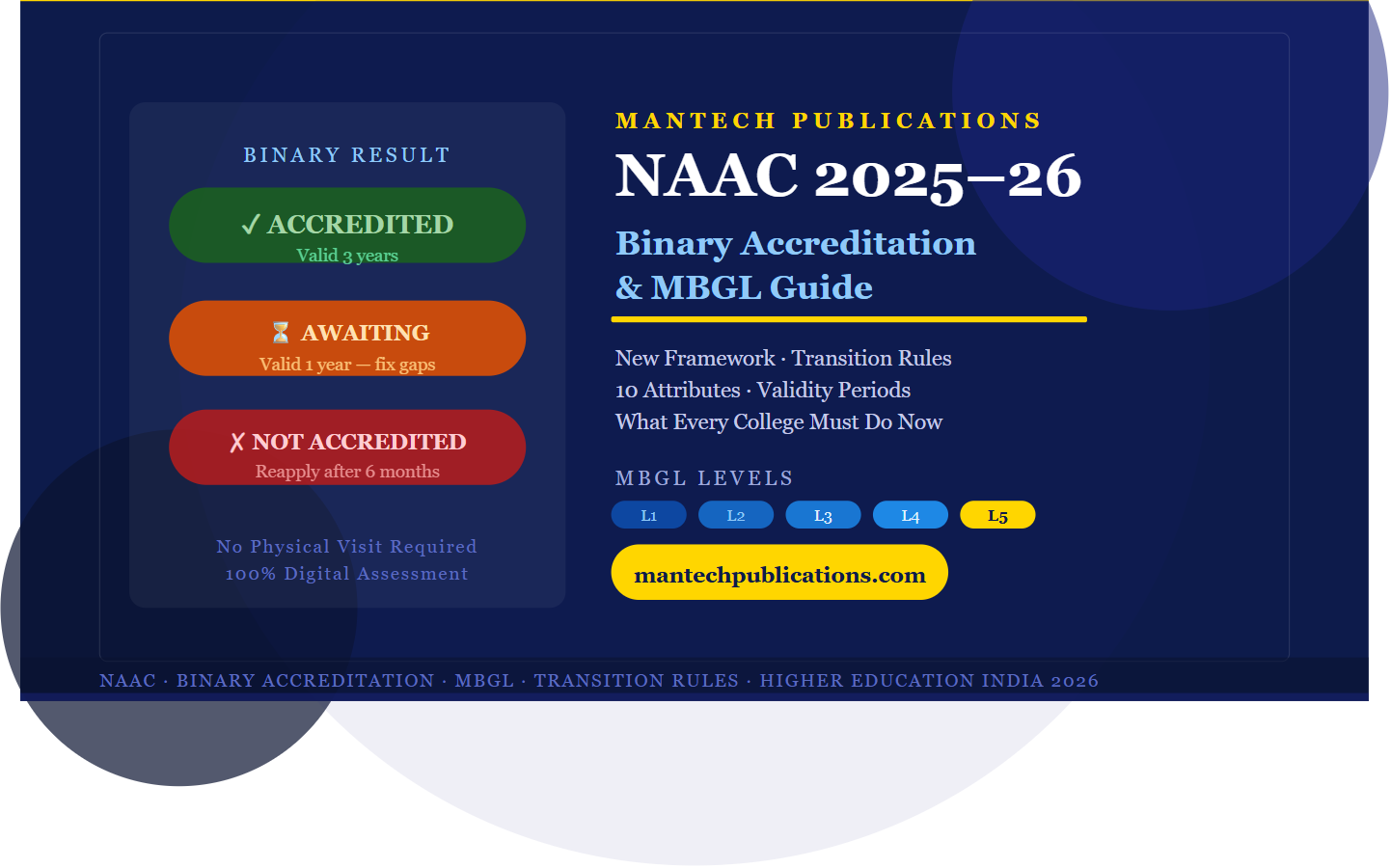
⚠️ Important Notice (June 2026): The NAAC Binary Accreditation portal has not yet launched officially. NAAC had initially indicated a launch around April–May 2025. No confirmed revised date has been announced. All institutions should use this waiting period to prepare thoroughly.
If you have been trying to make sense of the sweeping changes NAAC announced in early 2025, you are not alone. Across India’s higher education landscape, college administrators, IQAC coordinators, and principals are asking the same questions: What exactly is Binary Accreditation? What do MBGL Levels 1 through 5 mean? What happens to my institution’s existing NAAC grade? And what should we be doing right now while the portal is still not live?
This guide from Mantech Publications — with over 11 years of experience supporting colleges and academic institutions across India — cuts through the confusion and gives you a complete, accurate picture of where NAAC stands in 2026 and what every institution needs to do.
1. What NAAC Is and Why It Has Become Non-Negotiable for Indian Colleges
The National Assessment and Accreditation Council (NAAC) is an autonomous institution under the University Grants Commission, established in 1994, headquartered in Bengaluru. Its core function is to evaluate whether a Higher Education Institution (HEI) meets defined quality benchmarks — and to certify it accordingly.
Think of it as the quality certification standard for Indian higher education. A NAAC-accredited institution has been independently assessed and found to meet national standards for teaching, research, governance, infrastructure, and student outcomes.
But here is the critical shift: NAAC is no longer merely advantageous. It has become operationally necessary. Here is why:
| Without NAAC Accreditation | With NAAC Accreditation |
| Ineligible for UGC central funding and grants | Eligible for all UGC schemes and RUSA funding |
| Cannot participate in NIRF national rankings | NIRF participation and ranking possible |
| No path to autonomous college status | A-grade and above can apply for autonomy |
| Programme-level NBA accreditation blocked | NBA accreditation becomes accessible |
| State affiliation renewal becoming difficult | Stronger standing with affiliating universities |
| Weaker student and faculty attraction | Institutional credibility significantly enhanced |
With the National Education Policy (NEP) 2020 actively driving quality reforms, multiple state governments have begun linking affiliation renewal and grade promotions to NAAC status. The institutions that treated accreditation as optional are now finding that position unsustainable.
Scale of the Gap
India has over 58,000 higher education institutions (AISHE 2021–22). Approximately 40% of universities and only 18% of colleges are currently accredited by NAAC. Over 36,000 institutions are yet to achieve accreditation — representing both an enormous policy gap and an urgent opportunity for every institution still outside the system.
2. Why the Old NAAC Grading System Was Replaced — and What Went Wrong
To understand the new framework, you need to understand why the old one had to go.
The Old Revised Accreditation Framework (RAF) — A Quick Summary
Under the RAF, institutions were assessed across 7 criteria and received a Cumulative Grade Point Average (CGPA) scored on a scale of 0 to 4. The CGPA was converted into a letter grade:
| Grade | CGPA Range | Category | Validity |
| A++ | 3.76 – 4.00 | Outstanding | 5 years |
| A+ | 3.51 – 3.75 | Excellent | 5 years |
| A | 3.01 – 3.50 | Very Good | 5 years |
| B++ | 2.76 – 3.00 | Good | 5 years |
| B+ | 2.51 – 2.75 | Above Average | 5 years |
| B | 2.01 – 2.50 | Average | 5 years |
| C | 1.51 – 2.00 | Satisfactory | 5 years |
| D / Not Accredited | Below 1.50 | Unsatisfactory | — |
Assessment included a mandatory Physical Peer Team Visit — 3 to 5 NAAC-nominated expert assessors visited the campus for 2 to 3 days. RAF applications officially closed on June 30, 2024.
The Corruption Crisis That Forced the Change
In February 2024, the Central Bureau of Investigation arrested 10 individuals — including members of a NAAC inspection committee — in connection with alleged bribery by an Andhra Pradesh deemed university in exchange for inflated accreditation grades. The case exposed systemic vulnerabilities: too much dependence on individual peer discretion, too little automated data verification, and no mechanism to catch manipulation early.
NAAC’s response was decisive. Approximately 900 assessors were removed. Results from one complete assessment cycle were nullified. Public trust in the system had collapsed to a point where fundamental reform was unavoidable.
The Dr. K. Radhakrishnan Committee — a high-level panel chaired by the former ISRO Chairman — was tasked with redesigning the framework. Their mandate: make it technology-driven, AI-based, data-verified, transparent, and resistant to human manipulation. The new framework was officially announced on February 10, 2025.
Old System vs New System — Side by Side
| Aspect | Old RAF System | New Framework (2025+) |
| Outcome Type | A++, A+, A, B++, B+, B, C, D | Accredited / Not Accredited + MBGL Levels 1–5 |
| Validity Period | 5 years (all grades) | 3 years (Binary) + 3 years (each MBGL level) |
| Physical Visit | Mandatory for every institution | Only from MBGL Level 3 onwards |
| Assessment Method | Peer team + subjective scoring | AI-based, digital, auto-verified data |
| Data Verification | Manual DVV process | Auto-validation vs AISHE, NIRF, UDISE+ |
| Grading Logic | CGPA on 0–4 scale | Good / Concern / Weak classification per metric |
| New Applications | Closed June 30, 2024 | Portal not yet launched (June 2026) |
3. Binary Accreditation — A Complete Explanation
Binary Accreditation is the entry point — the threshold gate — of the new NAAC framework. The name is intentionally precise: the result is binary. Either your institution is Accredited or it is Not Accredited. There are no intermediate grades, no A++, no B+. Just two outcomes.
This is a fundamental philosophical shift. The old RAF asked: ‘How good are you?’ The new framework first asks: ‘Do you meet the minimum bar?’ Only once you clear that bar can you pursue higher recognition through MBGL.
Three Possible Binary Assessment Outcomes
| Result | What It Means | Validity | Next Step |
| Accredited | Institution clears all minimum quality benchmarks | 3 years | Optional: apply for MBGL |
| Awaiting Accreditation | Close to the threshold but some gaps remain | 1 year | Address gaps and reapply within 1 year |
| Not Accredited | Does not meet the minimum baseline standards | — | May reapply after 6 months |
How Binary Assessment Actually Works — No Physical Visit
This is perhaps the most significant operational change in the new framework: there is no physical peer team visit in Binary Accreditation. The entire process is digital.
Institutions submit all data and supporting evidence through the NAAC portal. An AI engine then benchmarks this data against peer groups and national averages. Approximately 100 stakeholders — randomly selected from students, alumni, faculty, employers, and administrative staff — participate in a digital validation survey.
Crucially, the new system uses a One Nation One Data Platform that cross-verifies institutional claims against three government databases simultaneously:
- AISHE — All India Survey on Higher Education
- NIRF — National Institutional Ranking Framework portal data
- UDISE+ — Unified District Information System for Education
Any mismatch between what an institution claims on the NAAC portal and what exists in these databases is automatically flagged and reduces the institution’s credibility score. This is why data accuracy — not just documentation volume — is the critical success factor in the new framework.
Who Is Eligible to Apply for Binary Accreditation?
Per current NAAC eligibility criteria, an institution must meet one of the following conditions before applying:
- Has been in existence for at least 6 years since establishment, OR
- Has had at least 2 batches of students complete their programme and graduate — whichever is earlier
The Radhakrishnan Committee has recommended simplifying this to a flat 6-year rule in upcoming revisions. Institutions that meet the eligibility threshold but have never applied must begin preparation now, as the portal is expected to go live without further delay once announced.
How Scoring Works: Good, Concern, and Weak
The new framework replaces the CGPA with a three-level classification for each metric: Good, Concern, or Weak. The final Binary outcome (Accredited / Awaiting / Not Accredited) is determined by the distribution of your metric scores across these three categories. Institutions with a high proportion of ‘Weak’ metrics will not achieve accreditation regardless of strong performance in other areas — there are minimum thresholds per criterion that must be individually met.
4. MBGL — The 5-Level Maturity Ladder After Binary
MBGL stands for Maturity-Based Graded Levels. After an institution achieves Binary Accreditation, it can choose to pursue MBGL — a five-level graded maturity model that replaces the old A++, A+, A, B++ grade structure.
MBGL is not mandatory. An institution can remain as simply ‘Accredited’ for its Binary validity period. But for institutions seeking UGC’s graded autonomy or higher recognition, MBGL becomes the pathway.
| Level | Name | Physical Visit? | What It Broadly Represents |
| Level 1 | Foundation | No — fully digital | Basic quality systems in place and functioning |
| Level 2 | Developing | No — fully digital | Consistent quality improvements visible across criteria |
| Level 3 | Established | Yes — virtual visit | Well-established quality culture and governance |
| Level 4 | Advanced | Yes — physical visit | Advanced institutional practices and research output |
| Level 5 | Excellence | Yes — full physical visit | Exemplary quality — benchmarked against global standards |
Each MBGL level carries its own 3-year validity period. An institution at Level 3 must re-apply and pass Level 3 assessment again within 3 years if it wishes to maintain that recognition — or it can attempt Level 4. Institutions cannot skip levels. Each level must be achieved sequentially.
Physical peer team visits are mandatory only from Level 3 onwards. Levels 1 and 2 remain entirely digital — making them accessible to institutions at earlier stages of quality development without the logistical complexity and cost of hosting a visit.
Mapping Old Grades to MBGL
The correspondence is approximate, not officially confirmed: MBGL Level 5 roughly corresponds to the old A++/A+. Level 4 roughly maps to A/B++. Level 3 to B+/B. Levels 1–2 represent the foundational quality threshold that replaces the lower old grades. Official MBGL benchmarks will be published when the portal launches.
5. Seven Criteria vs Ten Attributes — Clearing the Confusion Once and For All
This is one of the most confusing aspects of the new framework, and it has led to significant misinformation circulating among college administrators. Here is the clear distinction:
The 7 Criteria — Still the Structural Foundation
The 7 criteria from the old RAF remain the broad structural domains of NAAC evaluation. They have not been replaced or removed. They are:
| Criterion | Name |
| C-1 | Curricular Aspects |
| C-2 | Teaching-Learning and Evaluation |
| C-3 | Research, Innovations and Extension |
| C-4 | Infrastructure and Learning Resources |
| C-5 | Student Support and Progression |
| C-6 | Governance, Leadership and Management |
| C-7 | Institutional Values and Best Practices |
The 10 Attributes — The New Operational Evaluation Units
The 10 Attributes are a new layer introduced by the Radhakrishnan Committee as the operational units within which the assessment actually happens. They sit alongside — not instead of — the 7 criteria. Think of the 7 criteria as the broad chapters and the 10 attributes as the specific assessment dimensions within each chapter.
The 10 attributes are:
- Academic Excellence and Rigour
- Research, Innovation and Knowledge Creation
- Governance, Leadership and Institutional Management
- Infrastructure, Technology and Digital Ecosystem
- Student Centricity and Holistic Development
- Industry Engagement and Societal Contribution
- Global and National Outlook
- Faculty Competence and Development
- Financial Sustainability and Resource Mobilisation
- Institutional Culture, Values and Best Practices
Understanding that 7 criteria and 10 attributes coexist — each serving a different structural purpose — removes a significant source of confusion. Institutions do not need to choose between them. Both apply simultaneously in the new framework.
6. Portal Status — Where Things Stand as of June 2026
This is the practical reality every institution must understand: the NAAC Binary Accreditation portal has not launched as of June 2026. NAAC had initially indicated a portal launch around April–May 2025 when the new framework was announced in February 2025. That date passed without launch. No revised confirmed date has been officially communicated.
Complete Timeline of Key Events
| Date | Event |
| 1994 | NAAC established under UGC Act |
| February 2024 | CBI arrests NAAC assessment committee members in bribery case involving Andhra Pradesh deemed university |
| 2024 (Mid-year) | NAAC removes ~900 assessors; nullifies one complete assessment cycle results |
| June 30, 2024 | Old RAF framework officially closes. No new applications accepted under old system. |
| February 10, 2025 | NAAC officially announces new Binary Accreditation + MBGL framework. Radhakrishnan Committee report released. |
| April–May 2025 | NAAC’s initially indicated portal launch window. Portal did NOT launch. |
| June 2026 (Now) | Portal still awaited. NAAC has not confirmed a revised launch date publicly. Institutions should continue preparation. |
What Should Institutions Do While Waiting?
The portal delay is actually an advantage for prepared institutions. Every month the portal remains unlaunched is a month your institution can use to close documentation gaps, strengthen IQAC functioning, align data with AISHE records, and complete internal mock assessments. Institutions that begin preparation now will be ready to apply the moment the portal opens — while others scramble.
7. Transition Rules — Which Group Does Your College Belong To?
The new framework divides all existing institutions into six distinct groups based on their current accreditation status. Each group has different transition rules. Identifying which group your institution belongs to is the single most important step in planning your NAAC strategy.
| Group | Institution Status | What This Institution Must Do |
| Group 1 | Never applied for NAAC before | Must apply for Binary Accreditation when portal opens. No existing grade to transition from. |
| Group 2 | Applied under RAF but was Not Accredited | Must apply fresh for Binary Accreditation. The old ‘Not Accredited’ outcome does not carry forward. |
| Group 3 | Valid RAF grade, expiring within 1 year from portal launch | Gets a 3-month extension beyond expiry. Must then apply for Binary Accreditation before extension ends. |
| Group 4 | Valid RAF grade with more than 1 year remaining | Can use remaining RAF validity. Must apply for Binary BEFORE existing grade expires. Critical: do not let the grade expire first. |
| Group 5 | RAF grade already expired, no reapplication done | Must apply fresh for Binary Accreditation. Lost RAF grade cannot be reinstated. |
| Group 6 | Newly established — not yet eligible | Must wait until 6-year eligibility is met or 2 batches graduate. Begin quality systems now. |
The Most Dangerous Scenario: Group 4 Institutions
Institutions in Group 4 — those with a currently valid RAF grade and more than one year of validity remaining — face the most critical planning decision. They must apply for Binary Accreditation and receive Binary Accreditation BEFORE their existing RAF grade expires.
If a Group 4 institution allows its RAF grade to expire before completing Binary Accreditation, it automatically falls into Group 5 status — and must start completely fresh, as if it had never been accredited. Years of accumulated quality work and an existing NAAC grade are lost entirely.
This is not a hypothetical risk. With the portal still unlaunched, institutions in Group 4 whose RAF grades expire in 2026 or 2027 are in an increasingly tight window. Preparation must begin now so that the application can be submitted and processed the moment the portal opens.
Group 3: The 3-Month Extension Rule
Institutions in Group 3 — with a valid RAF grade expiring within one year from the portal launch date — receive an automatic 3-month extension beyond their scheduled expiry. This extension is a buffer, not a solution. The institution must submit and complete its Binary Accreditation application within that extension window or lose its accredited status.
8. Validity Periods — The Consequences of Waiting Too Long
Under the new framework, every accreditation outcome has a defined validity period. Understanding these periods is essential for planning your institution’s NAAC calendar.
| Accreditation Status | Validity Period | What Happens at Expiry |
| Binary: Accredited | 3 years | Must reapply for Binary or advance to MBGL before expiry |
| Binary: Awaiting Accreditation | 1 year | Must fix gaps and reapply within 1 year or fall to Not Accredited |
| MBGL Level 1 | 3 years | Must reapply for Level 1 or advance to Level 2 before expiry |
| MBGL Level 2 | 3 years | Must reapply for Level 2 or advance to Level 3 before expiry |
| MBGL Level 3 | 3 years | Must reapply for Level 3 or advance to Level 4 before expiry |
| MBGL Level 4 | 3 years | Must reapply for Level 4 or advance to Level 5 before expiry |
| MBGL Level 5 | 3 years | Must reapply for Level 5 to maintain recognition |
Scenario A: Institution Gets Binary Accreditation — Then Sits Idle for 5 Years
Binary Accreditation is valid for 3 years. If the institution takes no action after receiving it and the 3-year period expires, the Binary Accreditation lapses. The institution must then reapply from scratch — as if it never had Binary Accreditation — and restart the process entirely.
Scenario B: Institution Reaches MBGL Level 2 — Then Sits Idle for 4 Years
MBGL Level 2 is valid for 3 years. If the institution does not renew or advance within 3 years, the Level 2 recognition expires. The institution does not automatically drop to Level 1 — it drops to Unaccredited status and must restart from Binary Accreditation.
The 3-yearly renewal cycle is a fundamental structural feature of the new framework. It rewards continuous quality improvement and penalises institutions that treat accreditation as a one-time achievement.
9. Real Scenarios — How Different Colleges Are Affected
To make the transition rules concrete, here are practical scenarios illustrating what different types of institutions face:
Scenario 1: Government College with A Grade — Valid Until December 2026
This institution is in Group 4. It has over 6 months of validity remaining when the portal launches. It must apply for Binary Accreditation, complete the digital assessment successfully, and receive Binary Accreditation BEFORE December 2026. If it does so, it transitions smoothly. If the portal launches in, say, October 2026, it will have very little time. Preparation must begin now.
Scenario 2: Private College with B+ Grade — Expired in 2025
This institution is in Group 5. Its RAF grade lapsed before the portal opened. It must apply fresh for Binary Accreditation with no transition benefit from the old grade. However, the quality systems it built for its old accreditation are still valuable evidence for Binary. The institution should compile and update all existing documentation.
Scenario 3: New College — Established 2020, First Batch Graduated 2024
This institution has had one graduating batch as of 2024 and will have its second in 2025. It falls into Group 6 — not yet eligible. It must wait for the second batch to graduate (or until 6 years from establishment — whichever is earlier) before applying. The founding team should use this time to establish a strong IQAC, begin data collection from day one, and build the institutional documentation infrastructure.
Scenario 4: University with A++ Grade — Valid Until 2027
This is Group 4. The university has approximately two years of validity remaining. It should not wait for the portal to confirm details before beginning internal preparation. The university’s IQAC must immediately audit all documentation against the new 10-attribute framework, identify gaps, and begin remediation. Universities with strong research output and governance systems are well-positioned to move directly to MBGL Level 4 or 5 once the framework is fully operational.
10. What Your Institution Must Do Right Now — A Practical Action Plan
Given that the portal has not yet launched, many institutions have fallen into a ‘wait and watch’ mode. This is precisely the wrong approach. Every month spent waiting without preparation is a month of competitive disadvantage. Here is your action plan:
Immediate Actions (This Month)
- Identify your transition group from the six groups described above and confirm the exact expiry date of your current accreditation status if applicable
- Audit your AISHE data — log into the AISHE portal and verify that every data point your institution has submitted matches your internal records. Any mismatch will be automatically flagged by the new AI-based system.
- Establish or revitalise your IQAC — ensure it is properly constituted per NAAC guidelines, meeting quarterly, and producing dated, signed minutes with Action Taken Reports
- Compile a master document index across all 7 criteria — listing what documents exist, what is missing, and what requires updating
Short-Term Actions (Next 3 Months)
- Begin criteria-wise documentation gap analysis — identify which metrics have complete supporting evidence and which have gaps
- Cross-verify all publication, placement, infrastructure, and financial data against audited records and AISHE submissions
- Ensure your institutional website is structured for accreditation compliance — all mandatory disclosures, faculty data, IQAC page, AQARs, and governance information must be publicly accessible
- Set up a research documentation system if not already in place — all faculty publications, funded projects, and consultancy must be centrally tracked
Medium-Term Actions (Next 6 Months)
- Prepare a complete institutional profile aligned with the 10-attribute framework — understanding how your existing documentation maps to each attribute
- Conduct a mock Binary Accreditation self-assessment using the available NAAC framework documents as a guide
- Submit pending AQARs to NAAC if any years are backlogged — AQAR compliance is one of the indicators the new system will evaluate
- Begin stakeholder preparation — ensure faculty, students, and administrative staff understand the quality systems and can speak to them confidently
11. Frequently Asked Questions About the New NAAC Framework
Will my existing NAAC grade (A++, A+, etc.) still be recognised?
Yes, for its remaining validity period. Existing RAF grades remain valid until their expiry date. However, after expiry, the old grade system no longer applies. Institutions must transition to the new Binary Accreditation framework — and from there, to MBGL if desired.
Can an institution jump from Binary directly to MBGL Level 3 or higher?
No. MBGL levels must be achieved sequentially — Level 1 before Level 2, Level 2 before Level 3, and so on. There are no shortcuts or level-skipping provisions in the current framework.
Is MBGL mandatory after Binary Accreditation?
No. An institution can remain as simply ‘Accredited’ under Binary for the 3-year validity period without pursuing MBGL. However, institutions seeking UGC graded autonomy, specific grant schemes, or higher visibility will need to progress through MBGL levels.
What happens to ongoing RAF applications that were in progress when the system closed?
RAF applications officially closed on June 30, 2024. Any application that was not completed and submitted before that date was effectively abandoned. Those institutions must now apply fresh under the new framework when the portal launches.
Will there be a physical visit for Binary Accreditation?
No. Binary Accreditation is entirely digital — no physical peer team visit. Physical visits are reintroduced at MBGL Level 3 (virtual visit) and Levels 4 and 5 (physical campus visit).
How does the new system verify that institutions are not manipulating data?
The One Nation One Data Platform cross-checks all institutional submissions automatically against AISHE, NIRF, and UDISE+ databases. Discrepancies are flagged by the AI system and directly affect the institution’s credibility score — without any human intervention that could be manipulated.
Is there any provision for institutions that genuinely struggled due to COVID disruptions?
The Radhakrishnan Committee acknowledged COVID disruptions in its recommendations. However, no specific exemption or relaxation mechanism has been officially announced in the current framework documents. Institutions should present accurate data as it stands and allow the benchmark comparisons to account for sector-wide disruptions contextually.
When exactly will the new portal launch?
As of June 2026, no confirmed official date has been announced. NAAC had indicated April–May 2025 at the time of the framework announcement. Institutions should monitor the official NAAC website (naac.gov.in) for announcements and not rely on third-party timelines.
12. What Is Not Yet Officially Confirmed — Being Honest About Uncertainty
Any guide on the new NAAC framework owes its readers transparency about what is still uncertain. The following aspects have been indicated or recommended by the Radhakrishnan Committee but have NOT yet been officially confirmed in binding NAAC notifications:
- The exact MBGL scoring rubric and benchmarks for each level — the committee outlined the structure but detailed benchmarks await official release
- Whether institutions with expired RAF grades will receive any transition benefit or must start completely fresh — currently the framework suggests fresh start but no formal notification exists
- The precise fee structure for Binary and MBGL applications — indicative ranges have been discussed but not officially gazetted
- The specific weightage of the digital stakeholder survey (100 respondents) in the final Binary score calculation
- Whether the 6-year eligibility rule will formally replace the 2-graduating-batch criterion as recommended by the committee
Mantech Publications will update this guide as official confirmations are published. For the most current official information, always refer to naac.gov.in directly.
Bhavya Gyan Consultants (BGC) provides expert NAAC readiness consultancy — from gap analysis and IQAC setup to documentation systems and Binary Accreditation preparation.
Visit bgcglobal.in | Call / WhatsApp: +91 70425 06851 | Email: mailtobhavyagyan@gmail.com
Official Sources and References
- NAAC Official Website
- UGC (University Grants Commission)
- AISHE Portal
- NIRF Portal
- Ministry of Education Press Release — February 10, 2025 (NAAC New Framework Announcement)
- Dr. K. Radhakrishnan Committee Report on NAAC Reforms (2025)
About Mantech Publications
Mantech Publications has been a trusted partner to colleges and academic institutions across India for over 11 years. We publish academic journals, support institutional compliance through content and documentation resources, and help colleges navigate India’s complex higher education quality landscape. This article is part of our ongoing NAAC education series for college administrators, IQAC coordinators, and institutional leadership.
© 2026 Mantech Publications. All rights reserved. This content is original and independently prepared. Not affiliated with NAAC or UGC.
Related posts:
![How to get NAAC Accreditation 2026]()
How to Get NAAC Accreditation: A Step-by-Step Strategic Roadmap for Higher Education Institutions
![Affordable college journals]()
Cost-Effective Subscription Strategies for Tier-3 Higher Education Institutes: A Practical Guide to …
![Digital Spine by mantechpublications]()
Redefining the Digital Spine: An Ergonomic Blueprint for the Modern Human
![Mantech-Publications-Journals Best NAAC Consultancy Services in India by Mantech Publications]()
Best NAAC Consultancy Services in India: How to Choose the Right Partner
![Naac grades are expiring-what to do by Mantech Publications]()
Why Colleges Fail in NAAC Accreditation Even After Good Work
![Mantech-Publications-Journals Best NAAC Consultancy Services in India by Mantech Publications]()
NAAC SSR Report Writing Made Easy: Format, Tips & Real Examples (2026 Guide)







Leave a Reply