


NAAC accreditation in 2026 is being driven by the new Binary Accreditation framework, 10 key criteria (attributes), and Maturity‑Based Graded Levels (MBGL) that go far beyond the old CGPA‑only system. For colleges across India, this is the right time to realign systems, documentation, and strategy—ideally with expert support from specialized NAAC consultants like Bhavya Gyan Consultants.
What’s Changing in NAAC Accreditation 2026?
NAAC traditionally evaluated institutions on 7 criteria, and that structure still underpins current manuals and SSR formats. Under the Binary Accreditation reforms, NAAC is shifting operationally to 10 key attributes that make the evaluation more granular and outcomes‑oriented.
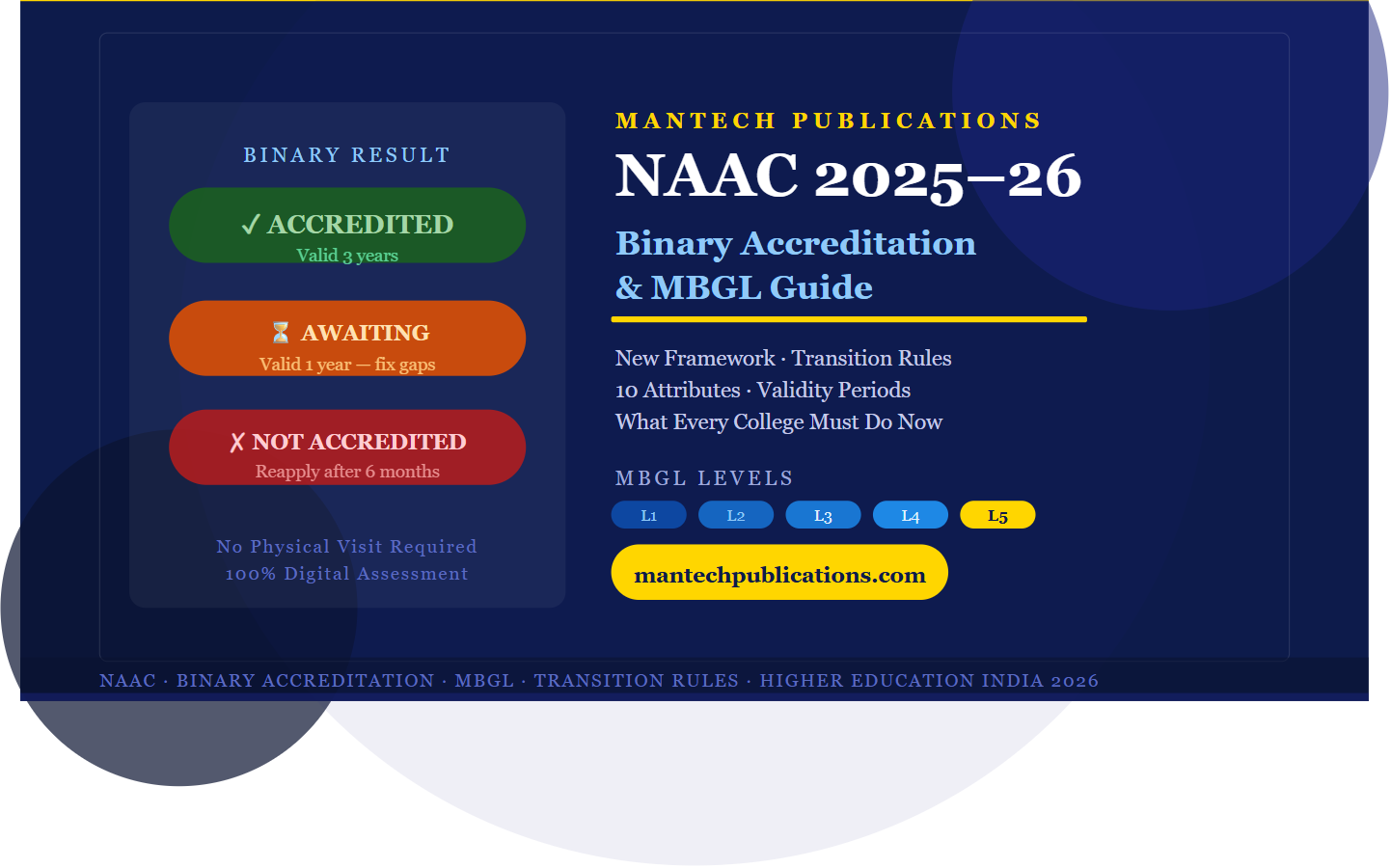
- Binary Accreditation (Basic): Institutions are classified as Accredited / Provisionally Accredited / Not Accredited based on minimum benchmarks across the 10 attributes.
- Maturity‑Based Graded Levels (MBGL): Accredited institutions can progress through higher levels (L1–L5) by demonstrating more mature systems, governance, and outcomes.
For 2026 cycles, colleges need to understand both the traditional 7‑criteria structure and the emerging 10‑criteria view, because data, policies, and evidence must satisfy both layers simultaneously.
NAAC’s New 10 Criteria / Key Attributes (2026 View)
Different official and expert documents describe slightly varied labels, but the core 10 attributes under the Binary framework consistently include the following themes:
- Curriculum
- Faculty Resources
- Infrastructure
- Financial Resources and Management
- Learning and Teaching
- Extended Curricular Engagements
- Governance and Administration
- Student Outcomes
- Research and Innovation Outcomes
- Sustainability Outcomes and Green Initiatives
A practical mapping for colleges (useful when planning SSR and internal audits) looks like this:
| New NAAC Attribute (10) | Linked Classic Criterion (7) | Focus for 2026 |
|---|---|---|
| Curriculum | Curricular Aspects | NEP 2020 alignment, CBCS, LOCF, flexibility, regular revision. |
| Faculty Resources | Teaching‑Learning & Evaluation | Faculty strength, qualifications, FDPs, mentoring, workload. |
| Infrastructure | Infrastructure & Learning Resources | Labs, library, ICT, accessibility, digital campus readiness. |
| Financial Resources & Management | Governance, Leadership & Management | Budgeting, audits, financial sustainability, resource planning. |
| Learning & Teaching | Teaching‑Learning & Evaluation | Student‑centric pedagogy, OBE, assessment reforms, LMS usage. |
| Extended Curricular Engagements | Student Support & Progression / Institutional Values | NSS/NCC, clubs, community engagement, outreach, extension. |
| Governance & Administration | Governance, Leadership & Management | Vision‑mission, decentralisation, e‑governance, IQAC. |
| Student Outcomes | Pass % trends, placement, higher studies, progression, alumni. | |
| Research & Innovation Outcomes | Publications, patents, start‑ups, consultancy, linkages. | |
| Sustainability & Green Initiatives | Green campus, energy, waste, SDGs, social responsibility. |
You can still write your SSR around the seven criteria, but internal quality planning, dashboards, and Board‑level presentations should be aligned to these 10 attributes to match the Binary mindset.
Why NAAC Accreditation 2026 Matters for Colleges Across India
In 2026, NAAC accreditation is directly linked with recognition, funding, reputation, and student choice.
Key reasons it is non‑negotiable:
- Eligibility for UGC grants, RUSA funding, and many central/state schemes.
- Stronger credibility with students and parents, improving admissions and retention in a highly competitive market.
- Better visibility in NIRF rankings, international collaboration, and industry MoUs.
- Mandatory or strongly preferred status for many universities/affiliating bodies when approving new programs or renewing affiliation.
For unaided private colleges and emerging institutions, systematic NAAC preparation can be the difference between growth and stagnation.
Planning NAAC accreditation 2026 under the new 10‑criteria Binary framework? Bhavya Gyan Consultants offers end‑to‑end NAAC consultancy services for colleges and universities across India—from 10‑criteria gap analysis and SSR drafting to DVV support, SSS planning, and mock peer‑team visits. Our team stays updated with the latest NAAC guidelines, Binary accreditation reforms, and MBGL expectations so that your institution not only becomes NAAC‑ready but builds a sustainable culture of quality and outcomes.
NAAC Accreditation 2026: Complete Step‑by‑Step Process (Updated)
The broad flow remains similar—Registration → IIQA → SSR → DVV → SSS → Visit → Outcome—but is now reinterpreted under the Binary + MBGL model and the 10 attributes.
Step 1: Institutional Readiness & 10‑Criteria Gap Analysis
Before touching the NAAC portal, conduct an internal NAAC readiness audit covering the last 5 years of data against all 10 attributes.
- Map departments and cells (IQAC, Examination, Research, Placement, NSS, etc.) to each attribute.
- Identify red‑flag gaps—weak student outcomes, poor financial documentation, limited environmental initiatives, etc.
- Prepare a NAAC‑specific action plan with tasks, owners, and timelines.
Bhavya Gyan Consultants typically begin every engagement with a structured 10‑criteria gap analysis and a predicted accreditation band under the Binary framework.
Step 2: NAAC Portal Registration
- Create an institutional account on the official NAAC portal and complete the institutional profile (type, programs, student strength, approvals).
- Upload required statutory documents and affiliations as per the latest manual for your category (University / Autonomous / Affiliated College).
- Pay registration fees as per NAAC guidelines.
Correct mapping at this stage prevents downstream issues in SSR metrics and DVV.
Step 3: IIQA – Institutional Information for Quality Assessment
- Submit IIQA with clear program‑wise details, faculty numbers, student data, and basic quality indicators required by NAAC.
- Ensure that all statutory approvals (AICTE, NMC, PCI, BCI etc.) are valid and uploaded in prescribed formats.
- Track NAAC communications closely and respond immediately to any clarification requests.
Bhavya Gyan Consultants help institutions package IIQA data so that it is consistent with future SSR disclosures and Binary criteria expectations.
Step 4: SSR – Self‑Study Report Aligned to 7 + 10 Criteria
- Prepare the SSR as per the latest NAAC manual (still structured around 7 criteria and QnM/QlM metrics).
- Internally, tag each metric to one or more of the 10 Binary attributes (curriculum, faculty, finance, outcomes, sustainability, etc.).
- Provide credible, dated, and traceable evidence for every metric—policies, minutes, reports, MoUs, data tables, photos, URLs.
A consultancy‑guided SSR ensures consistency between numeric data, narratives, and documentary proof, which is crucial in AI‑aided validation.
Step 5: DVV – Data Validation & Verification Under Binary Framework
- After SSR submission, NAAC appoints a DVV partner to cross‑check quantitative metrics against uploaded evidence.
- Expect structured DVV queries on discrepancies, outliers, or incomplete evidence, with tight reply timelines.
- Under the Binary model, unresolved inconsistencies can drag an institution from Accredited to Provisionally Accredited or even Not Accredited.
Bhavya Gyan Consultants typically set up a dedicated DVV war‑room: metric‑wise teams, evidence owners, and standardized reply formats.
Step 6: Student Satisfaction Survey (SSS) & Student Outcomes
- NAAC conducts an online Student Satisfaction Survey using student contact data you provide.
- Questions focus heavily on teaching‑learning quality, fairness, infrastructure, and overall satisfaction—directly linked to the “Learning & Teaching” and “Student Outcomes” attributes.
- Colleges must sanitize data (correct emails), brief students ethically, and have robust grievance and mentoring systems in place.
From a Binary perspective, weak student outcomes and feedback can be fatal even if documentation is strong.
Step 7: Peer Team Visit (Hybrid / MBGL Levels)
- Depending on NAAC’s mode of assessment and your MBGL aspirations, a peer team may visit your campus.
- The team verifies key areas across all 10 criteria—curriculum, faculty quality, labs, finances, sustainability practices, governance, and stakeholder engagement.
- Structured presentations, department‑wise displays, and a central documentation room tuned to the 10‑attribute story significantly influence the qualitative impression.
Mock peer‑team visits conducted by Bhavya Gyan Consultants help colleges rehearse responses, walkthroughs, and presentations.
Step 8: Accreditation Result, MBGL Level & Next‑Cycle Strategy
- NAAC announces the Binary result (Accredited / Provisionally Accredited / Not Accredited) and, where applicable, your MBGL level.
- Accreditation validity is generally 3 years, with mandatory AQAR submissions and continuous compliance.
- Institutions should immediately integrate NAAC’s recommendations into their strategic plan, budget, and IQAC agenda.
Consultancies can convert the NAAC report into a practical 3‑year quality roadmap, with targeted improvements for each of the 10 attributes.
NAAC Accreditation Documentation for the 10 Criteria
Because AI‑driven validation and sample‑based scrutiny are increasing, meticulous documentation for all 10 criteria is essential in 2026.
Must‑have documentation sets include:
- Curriculum and Academic: BoS minutes, syllabus revisions, NEP implementation notes, CBCS/LOCF documents.
- Faculty Resources: Appointment letters, service records, workload, FDPs, appraisals, performance reports.
- Infrastructure: Asset registers, lab inventories, AMC records, library usage statistics, ICT and LMS logs.
- Financial Resources: Budget approval minutes, audited statements, utilisation certificates, fee policies.
- Learning & Teaching: Timetables, lesson plans, internal assessment schemes, learning analytics.
- Extended Engagements: NSS/NCC reports, outreach photos, MoUs for community partnerships.
- Governance & Administration: Governing body minutes, organograms, HR policies, grievance redressal records.
- Student Outcomes: Result analysis, placement records, progression data, alumni database.
- Research & Innovation: Publication lists, patent documents, start‑up/incubation records, consultancy income.
- Sustainability & Green: Energy audits, waste management policies, green campus initiatives, SDG mapping.
Bhavya Gyan Consultants provide metric‑wise document checklists, file‑naming conventions, and shared‑drive structures that make retrieval easy for DVV and peer teams.
How Bhavya Gyan Consultants Support NAAC Accreditation Pan‑India
As a pan‑India NAAC consultancy, Bhavya Gyan Consultants focuses exclusively on helping colleges and universities navigate the new 10‑criteria Binary framework and MBGL levels.
Our typical NAAC consultancy services include:
- 10‑Criteria Diagnostic & Readiness Report: Attribute‑wise scoring, risk flags, and a realistic Binary/MBGL projection.
- IQAC & Policy Architecture: Drafting and standardizing policies, SOPs, and handbooks across academics, HR, research, and sustainability.
- SSR Strategy & Drafting Support: Metric‑wise templates, data models, narrative design, and editorial review tuned to NAAC style.
- DVV Strategy, Evidence Mapping & Reply Support: Setting up DVV teams, de‑duplicating evidence, and preparing precise response notes.
- SSS / Stakeholder Engagement Plan: Orientation sessions, communication strategy, and student outcome tracking models.
- Mock Peer‑Team Visit: Full‑day rehearsal of presentations, campus walkthrough, and Q&A simulations with management, faculty, and students.
- Post‑Accreditation Roadmap: 3‑year action plan tagged to all 10 attributes, AQAR formats, and MBGL level‑up strategy.
Whether you are an unaided private college, an autonomous institution, or an emerging university, partnering with a specialized NAAC consultant helps you turn accreditation from a one‑time stress event into a continuous quality movement.
FAQs:
Under the updated NAAC framework, evaluation is interpreted through 10 key attributes: curriculum, faculty resources, infrastructure, financial resources and management, learning and teaching, extended curricular engagements, governance and administration, student outcomes, research and innovation outcomes, and sustainability or green initiatives. These build on the classic seven criteria but give NAAC a more granular, outcomes-focused lens for Binary Accreditation and MBGL levels.
In the Binary framework, NAAC classifies institutions as Accredited, Provisionally Accredited, or Not Accredited based on whether they meet minimum benchmarks across the 10 criteria. Data is submitted digitally through SSR, validated via DVV and Student Satisfaction Survey, and in some cases complemented by a peer team visit. Accredited institutions can then opt to be placed on Maturity-Based Graded Levels to showcase higher quality and governance maturity.
Binary Accreditation confirms that an institution meets NAAC’s essential quality standards across all 10 criteria. Maturity-Based Graded Levels, or MBGL, go further by assigning the institution to a level that reflects the depth and maturity of its systems, governance, research, outcomes, and sustainability practices. In simple terms, Binary is about basic compliance, while MBGL is about continuous improvement and excellence.
Preparation typically includes a 10-criteria gap analysis, strengthening IQAC and policies, systematic documentation for the last five years, structured SSR drafting aligned with both the seven classic criteria and the new 10 attributes, timely DVV query handling, SSS preparedness, and a rehearsal of the NAAC peer team visit. Working with an experienced NAAC consultancy like Bhavya Gyan Consultants helps colleges plan and execute each step without last-minute surprises
Key document sets include curriculum and BoS minutes, NEP implementation records, faculty appointment and FDP records, infrastructure and ICT logs, audited financial statements, student support and outcome data, research and innovation proofs, and sustainability or green campus evidence. Each metric in the SSR should have clear, dated, and verifiable evidence that can be quickly retrieved during DVV and peer team visits.
NAAC guidelines, the Binary framework, and MBGL levels are evolving quickly, and many colleges struggle with data consistency, documentation, and DVV responses. Bhavya Gyan Consultants offers pan-India NAAC support, including 10-criteria gap analysis, SSR drafting support, DVV guidance, SSS planning, and mock peer team visits, helping institutions reduce risk, save time, and improve their chances of securing a strong accreditation status
Related Links:
Latest Posts:
- How to Get NAAC Accreditation: A Step-by-Step Strategic Roadmap for Higher Education Institutions
- Cost-Effective Subscription Strategies for Tier-3 Higher Education Institutes: A Practical Guide to Affordable College Journals
- NAAC New Accreditation System 2025–26: Binary Accreditation, MBGL Levels, and What Every Indian College Must Know
- Redefining the Digital Spine: An Ergonomic Blueprint for the Modern Human
- Best NAAC Consultancy Services in India: How to Choose the Right Partner
Related posts:
![How to get NAAC Accreditation 2026]()
How to Get NAAC Accreditation: A Step-by-Step Strategic Roadmap for Higher Education Institutions
![Affordable college journals]()
Cost-Effective Subscription Strategies for Tier-3 Higher Education Institutes: A Practical Guide to …
![NAAC-New-Accreditation-System-2025–26 by mantech Publications]()
NAAC New Accreditation System 2025–26: Binary Accreditation, MBGL Levels, and What Every Indian Coll…
![Mantech-Publications-Journals Best NAAC Consultancy Services in India by Mantech Publications]()
Best NAAC Consultancy Services in India: How to Choose the Right Partner
![Naac grades are expiring-what to do by Mantech Publications]()
Why Colleges Fail in NAAC Accreditation Even After Good Work
![Mantech-Publications-Journals Best NAAC Consultancy Services in India by Mantech Publications]()
NAAC SSR Report Writing Made Easy: Format, Tips & Real Examples (2026 Guide)





Leave a Reply